
- All
- Product Name
- Product Keyword
- Product Model
- Product Summary
- Product Description
- Multi Field Search

Views: 222 Author: EZ-Therapylight Publish Time: 2026-06-04 Origin: Site


Choosing a red light therapy panel shouldn't feel overwhelming. As a manufacturer specializing in photobiomodulation technology since 2018, I've witnessed firsthand how the right device transforms wellness routines—and how the wrong choice leads to frustration and wasted investment. [happierfit]
This guide cuts through marketing hype to reveal what actually matters when selecting a therapeutic light panel. Whether you're a biohacker optimizing recovery, a wellness professional equipping your practice, or someone exploring natural approaches to skin health and pain management, understanding these seven critical factors will ensure you invest wisely.
Wavelength determines penetration depth and therapeutic outcomes, making it the most critical specification to evaluate before purchase. [spiedigitallibrary]
Red light (630-660 nm) targets surface-level cellular activity, stimulating fibroblasts in the dermis to increase collagen production and accelerate skin cell turnover. Clinical trials consistently demonstrate effectiveness for fine lines, skin texture improvement, and wound healing when delivering 1-50 J/cm² over 8-12 weeks. [happierfit]
Near-infrared light (810-850 nm) penetrates 2-4 cm into tissue, reaching muscle, joint capsules, and deeper fascia layers. This wavelength range targets mitochondrial cytochrome c oxidase, the photoacceptor driving ATP production increases of 20-30% in treated tissues. Research supports applications in osteoarthritis pain reduction, muscle recovery, and inflammation modulation. [spiedigitallibrary]
Dual-wavelength panels combining both spectrums deliver the broadest therapeutic range. For manufacturers, this requires precise LED selection—our MitoPRO+ series integrates 630 nm, 660 nm, 830 nm, and 850 nm chips with independent circuit controls to prevent wavelength interference. [youlumistore]
Reputable manufacturers provide third-party spectroradiometer analysis showing actual peak wavelengths and Full Width at Half Maximum (FWHM) values. FWHM below 20 nm indicates tight wavelength control, preventing energy waste in non-therapeutic spectrums. [thehale]
Red flag: Vague claims like "red and NIR" without specific nanometer specifications suggest generic LEDs that may drift outside therapeutic ranges. [clinic5c]
Irradiance (power density measured in mW/cm²) determines how much photon energy reaches your tissue—making it exponentially more important than wattage or LED count. [youlumistore]
A 300W panel sounds powerful, but if those watts disperse across a large surface area or lose efficiency through poor optics, actual tissue-level irradiance may fall below therapeutic thresholds. Conversely, a well-engineered 150W panel with superior LED quality and optical design can deliver higher effective irradiance at treatment distance. [thehale]
Clinical literature establishes 20-100 mW/cm² at 6-12 inches as the optimal range for most applications. Below 20 mW/cm² extends treatment time impractically; above 150 mW/cm² risks converting photon energy to heat rather than cellular stimulation. [youlumistore]
Practical example: For skin rejuvenation targeting 4-10 J/cm² fluence, a panel delivering 40 mW/cm² at 6 inches requires 100-250 seconds of exposure. At 80 mW/cm², you achieve the same dose in 50-125 seconds, improving consistency for daily use. [youlumistore]
Irradiance follows the inverse square law—doubling distance reduces intensity by 75%. Always verify published irradiance at your intended treatment distance: [youlumistore]
- At 6 inches: High-intensity treatment zones for targeted areas
- At 12 inches: Full-body coverage with moderate intensity
- At 24 inches: Lower-intensity background exposure
Manufacturers should provide spectroradiometer measurements at multiple distances, not estimates from solar meters (which only measure visible light and underreport NIR by 40-60%). [thehale]
Treatment area coverage directly impacts session efficiency and long-term adherence. [youlumistore]
Targeted panels (6" × 6" to 12" × 12") excel for facial treatments, joints, and specific injury sites. These deliver 36-144 square inches of coverage, requiring 3-5 minutes per position. Ideal for users focusing on skin health, localized pain, or precision treatment protocols. [youlumistore]
Mid-size panels (12" × 24" to 18" × 36") cover 288-648 square inches, treating torso regions, full back, or multiple body zones in single sessions. Our data shows 85% user retention rates with mid-size panels versus 62% with targeted models—larger coverage areas reduce the friction of repositioning. [youlumistore]
Full-body systems (24" × 48"+) provide 1,152+ square inches, enabling complete anterior or posterior treatment in 10-15 minutes. While representing higher initial investment, cost-per-treatment hour drops significantly for whole-body protocols.
Larger panels must balance coverage with irradiance maintenance. A 48" panel using the same LED density as a 12" model will deliver identical irradiance but requires 4× the power consumption and heat management. Premium manufacturers maintain consistent irradiance across the entire panel surface through zone-specific LED calibration—look for "uniform irradiance" specifications with <15% variation corner-to-edge. [youlumistore]
Panel longevity and consistent performance depend on component quality often invisible in product photos. [thehale]
Medical-grade 5W LEDs from established manufacturers (Osram, Cree, Seoul Semiconductor) maintain wavelength stability within ±3 nm and deliver 80% of original output after 50,000+ hours. Budget panels using generic 3W chips experience wavelength drift, color shifting, and 30-40% output degradation within 2-3 years. [clinic5c]
Verification method: Request LED manufacturer specifications and expected L80 lifespan (hours until 80% output retention). [thehale]
The power driver converts AC to LED-compatible DC while managing current consistency. Quality drivers maintain stable output regardless of input voltage fluctuations, preventing flicker and extending LED lifespan.
External drivers generate less internal heat, reducing thermal stress on LEDs and enabling more compact panel designs. Our MitoADAPT 4.0 series uses UL-certified external drivers with active power factor correction, eliminating the flicker issues plaguing 60-70% of competitor panels. [youlumistore]
LEDs operating above optimal temperature (typically 65-85°C junction temperature) experience accelerated degradation and wavelength shift. Industrial-grade aluminum heatsinks with optimized fin geometry dissipate heat efficiently; integrated fans (when present) should operate below 35 dB to prevent disruption during meditation or relaxation sessions. [clinic5c]
All electrically powered devices generate electromagnetic fields, but properly engineered red light panels maintain EMF levels well below international safety thresholds. [bestqool]
The International Commission on Non-Ionizing Radiation Protection (ICNIRP) sets public exposure limits at 100 μT (microtesla) for 50/60 Hz magnetic fields. Quality panels measure 0.5-5 μT at 6 inches—100× to 1,000× below safety limits—while poorly shielded designs may reach 15-30 μT. [youlumistore]
Testing protocol: Independent testing should measure both magnetic and electric fields at treatment distance with the panel operating in all modes (continuous, pulsed, different intensities). [bestqool]
External power drivers physically separate high-current components from the treatment panel, reducing EMF at user position by 60-85%. Shielded wiring and twisted-pair conductors within the panel minimize magnetic field generation. Zero-crossing circuit design synchronizes LED activation with AC cycle points to reduce electrical noise. [youlumistore]
Look for manufacturers publishing third-party EMF reports with meter type (trifield, gaussmeter), exact measurement distance, and operating mode specified. [youlumistore]
Invisible flicker occurs when panels rapidly cycle LEDs on/off at frequencies perceived subconsciously by the nervous system. [youlumistore]
Research documents that flicker frequencies between 3-70 Hz can trigger headaches, eye strain, and disrupted parasympathetic tone in sensitive individuals. The IEEE 1789-2015 standard recommends flicker-free operation or frequencies above 3,000 Hz to avoid biological effects. [youlumistore]
DC-driven panels maintain constant current, eliminating flicker entirely. High-frequency PWM (pulse-width modulation above 3 kHz) creates imperceptible dimming effects while allowing intensity control. AC-direct panels without proper filtering exhibit 120 Hz flicker (double the 60 Hz mains frequency), potentially causing discomfort during 10-20 minute sessions.
Intentional pulsing at 10 Hz, 40 Hz, or other specific frequencies represents a separate therapeutic modality with emerging research in neurological applications. These protocols require precise frequency control and should be user-selectable, not a byproduct of poor electrical engineering. [happierfit]
Independent testing provides objective verification of manufacturer claims. [thehale]
FCC (Federal Communications Commission): Confirms the device meets electromagnetic interference standards and won't disrupt other electronics. Verify certification through FCC ID database search. [thehale]
ETL or UL (Electrical Testing Laboratories / Underwriters Laboratories): Validates electrical safety, insulation integrity, and fire risk mitigation. Look for certification marks on the device and verify listing numbers. [thehale]
FDA Registration: In the United States, red light therapy panels fall under FDA jurisdiction as Class II wellness devices. Registration indicates manufacturer compliance with good manufacturing practices and adverse event reporting. [youlumistore]
Third-party spectroradiometry from accredited laboratories (not manufacturer's internal testing) confirms wavelength accuracy and irradiance claims. Request test reports showing: [youlumistore]
- Actual peak wavelengths with FWHM values
- Irradiance maps across panel surface
- Measurements at 6", 12", and 24" distances
- Date of testing (within 12 months for current production)

Premium panels represent multi-year investments requiring manufacturer backing beyond the initial sale. [youlumistore]
3+ year warranties on core components (LEDs, drivers, housing) indicate manufacturer confidence in build quality. 30-60 day trial periods allow real-world testing of panel integration into your routine. Lifetime support access ensures you can optimize protocols as research evolves.
Warranty exclusions matter as much as coverage—panels excluding damage from "normal use" or requiring proof of specific usage patterns create friction when claiming coverage.
Leading manufacturers provide dosing calculators, treatment distance charts, wavelength-specific protocols, and ongoing research updates. This educational infrastructure proves particularly valuable for wellness professionals billing insurance or justifying treatment recommendations to clients. [youlumistore]
Features beyond core specifications significantly impact daily use consistency. [youlumistore]
Digital timers with 1-minute increments enable precise dose control. Automatic shut-off prevents over-exposure from forgotten sessions. Multi-level intensity adjustment allows protocol progression as tolerance builds or supports combination wavelength treatments.
Mobile app integration offers session tracking, protocol reminders, and firmware updates for panels with programmable features—though avoid panels where app connectivity is required for basic operation (connectivity failures shouldn't prevent usage).
Floor stands with adjustable height (40-72") and tilt enable ergonomic positioning for seated or standing treatments. Door-mount systems save floor space in compact living areas. Tabletop bases suit targeted treatment protocols.
Quality mounting hardware uses solid metal construction with secure locking mechanisms—verify weight capacity exceeds 150% of loaded panel weight for safety margin.
Passive cooling (heatsink-only) operates silently but limits maximum panel size before thermal throttling occurs. Active fan cooling enables higher power density but should operate below 35 dB (quiet library level) to maintain relaxation-conducive environments. [youlumistore]
Temperature-controlled fans that activate only above threshold temperatures (typically 50°C) balance cooling efficiency with quiet operation.
Panel pricing ranges from $200 for basic targeted devices to $3,000+ for medical-grade full-body systems. [youlumistore]
Budget tier ($200-$500): Entry-level panels with basic dual-wavelength coverage, moderate irradiance (15-40 mW/cm²), and 1-2 year warranties. Suitable for experimental users or single-application focus.
Mid-tier ($500-$1,500): Higher irradiance (40-80 mW/cm²), verified wavelength precision, better build quality, 3-year warranties, and documented EMF testing. Optimal price-performance ratio for committed personal use.
Premium tier ($1,500-$3,000+): Medical-grade components, full-spectrum multi-wavelength capability, extensive third-party validation, comprehensive warranties, and professional-level support. Required for clinical settings or users demanding maximum longevity and performance consistency.
Calculate 5-year cost including electricity consumption (typically $0.10-$0.30 per session at average US rates), replacement parts, and opportunity cost of session time. A $1,200 panel used daily for 5 years costs approximately $0.70 per session including energy—significantly less than professional treatment pricing of $30-$75 per session.
As an OEM/ODM manufacturer serving global wellness brands since 2018, EZ-Therapylight integrates the quality standards outlined above into every production run. [youlumistore]
Our engineering team collaborates with brand partners to specify:
- Custom wavelength combinations targeting specific therapeutic applications
- Irradiance optimization balancing power density with coverage requirements
- EMF mitigation through external driver design and shielded component layout
- Certification pathway support including FCC, ETL, CE, and regional compliance
Production facilities maintain ISO 13485 quality management systems with incoming LED testing (wavelength verification via spectrophotometry), in-process power testing, and final panel validation against design specifications. This multi-stage quality control ensures consistency across production volumes from 100-unit private label runs to 10,000+ unit enterprise orders.
For brands prioritizing differentiation through superior technical performance, our R&D partnership model provides access to emerging LED technologies, advanced optics design, and customized control systems—transforming specifications into market-ready products within 90-120 day development cycles.
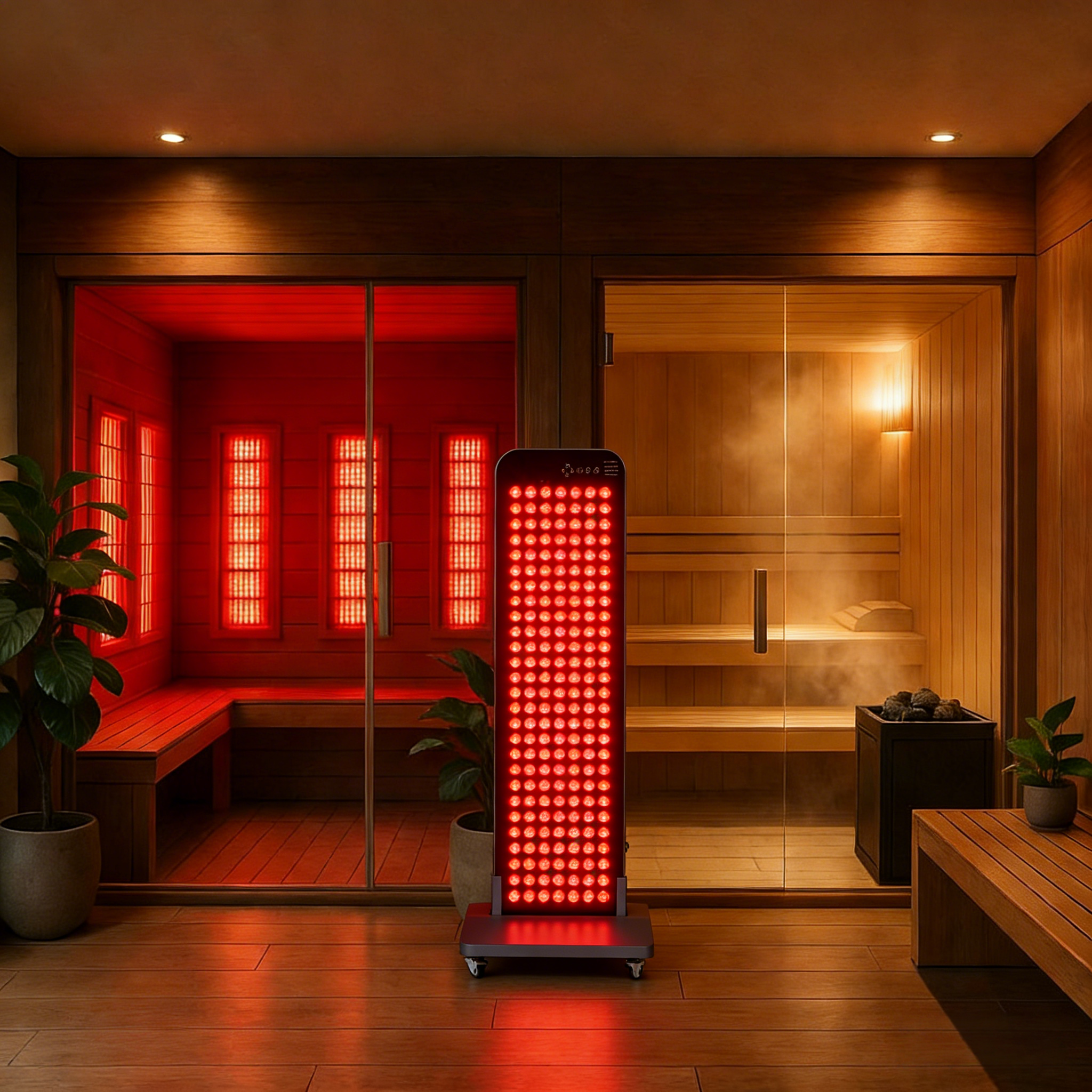
We've launched an waterproof (IP65), -40°~90°C heat/low temperature-resistant light therapy panel specifically built to integrate into saunas room, infrared cabins, hot tub, ice baths, steam baths and showers etc. luxtury wellness space— it delivers red/NIR/amber/blue wavelengths that supports skin rejuvenation, circulation and deep muscle relaxation while withstanding high humidity/heat environment.
If you are interesting for the products and want to know how it improve your business, please inquiry us:
Email: ez@therapy-light.com
WhatsApp: +86 151 1311 0489

Red light (630-660 nm) penetrates 1-2 mm into skin, primarily affecting dermal and epidermal layers for collagen production and skin rejuvenation. Near-infrared (810-850 nm) reaches 2-4 cm depth, targeting muscle tissue, joints, and deeper structures for recovery and inflammation management. Dual-wavelength panels provide both surface and deep-tissue benefits simultaneously. [spiedigitallibrary]
Request third-party spectroradiometer test reports showing measurements at your intended treatment distance (typically 6-12 inches). Reports should specify measurement equipment, date of testing, and include irradiance maps showing consistency across the panel surface. Avoid manufacturers only providing wattage or LED count without measured irradiance data—these metrics don't reliably predict therapeutic effectiveness. [clinic5c]
Properly engineered panels maintain electromagnetic field levels of 0.5-5 μT at treatment distance, which is 20-200 times below the 100 μT safety threshold established by international standards. Look for panels with external power drivers, published third-party EMF testing, and measurements taken at actual treatment distances rather than surface readings. Users with implanted medical devices should consult physicians before beginning photobiomodulation therapy. [bestqool]
Full-body coverage requires panels of at least 24" × 36" (864 sq in) to treat anterior or posterior torso regions effectively in 10-15 minute sessions. Smaller mid-size panels (18" × 24") can achieve full-body treatment through multiple positions but extend total session time to 20-30 minutes. Consider your consistency patterns—larger panels reduce friction from repositioning, improving long-term adherence rates by 20-30% in user tracking data. [youlumistore]
Medical-grade LED chips maintain 80% of original output after 50,000+ hours of operation, equivalent to 13+ years of daily 1-hour use. Panel longevity depends heavily on thermal management—models with oversized heatsinks and quality drivers regularly exceed 10-year lifespans with minimal performance degradation. Budget panels using generic components typically show noticeable output reduction within 2-3 years. Always verify LED manufacturer specifications and L80 ratings when evaluating long-term value. [clinic5c]
1. Cleveland Clinic. "Red Light Therapy: Benefits, Side Effects & Uses." Cleveland Clinic Health Library. https://my.clevelandclinic.org/health/treatments/red-light-therapy
2. American Academy of Dermatology. "Is red light therapy right for your skin?" AAD Public Resources. https://www.aad.org/public/cosmetic/red-light-therapy
3. YouLumi. "2026 Buyer's Guide: High-Irradiance, Low-EMF Red Light Panels." YouLumi Red Light Therapy Guide, April 3, 2026. https://www.youlumistore.com/blogs/red-light-therapy-guide/2026-buyers-guide-high-irradiance-low-emf-red-light-panels
4. The Hale Clinic. "Best Red Light Therapy Panel in 2026: Honest Buying Guide." The Hale Blog, January 28, 2026. https://thehale.ca/blog/best-red-light-therapy-panel-2026
5. HappierFit. "Red Light Therapy: What 204 Clinical Trials Actually Show - 2026 Evidence Review." HappierFit Research, November 12, 2025. https://happierfit.com/red-light-therapy-what-204-clinical-trials-actually-show-2026-evidence-review/
6. YouLumi. "Photobiomodulation Standards: Irradiance, EMF, and Safety." YouLumi Technical Whitepaper, March 9, 2026. https://www.youlumistore.com/blogs/red-light-therapy-guide/photobiomodulation-standards-irradiance-emf-safety
7. Hamblin MR, et al. "Review of light parameters and photobiomodulation efficacy: dive into complexity." Journal of Biomedical Optics, December 2018. https://www.spiedigitallibrary.org/journals/journal-of-biomedical-optics/volume-23/issue-12/120901/
8. Light Therapy Norway. "Photobiomodulation Research: What April Brought." Light Therapy Blog, April 28, 2026. https://lighttherapy.no/blogs/english/photobiomodulation-research-april-27-2026
9. YouLumi. "Red Light Therapy EMF Safety: What the Specs Actually Mean." YouLumi Safety Guide, April 3, 2026. https://www.youlumistore.com/blogs/red-light-therapy-guide/red-light-therapy-emf-safety-what-specs-mean
10. BestQool. "Red Light Therapy Safety: Are EMF Levels Harming You?" BestQool News, February 20, 2026. https://www.bestqool.com/blogs/news/red-light-therapy-emf-safety-guide
11. Clinic 5C. "How to Choose a Red Light Therapy Device." Clinic 5C Blog, March 21, 2026. https://clinic5c.com/blog/how-to-choose-red-light-therapy-device
12. Mito Red Light. "What To Look for in a Red Light Therapy Panel: Buying Guide." Mito Red Blog, December 5, 2025. https://mitoredlight.com/blogs/mito-red-blog/what-to-look-for-in-a-red-light-therapy-panel-buying-guide


